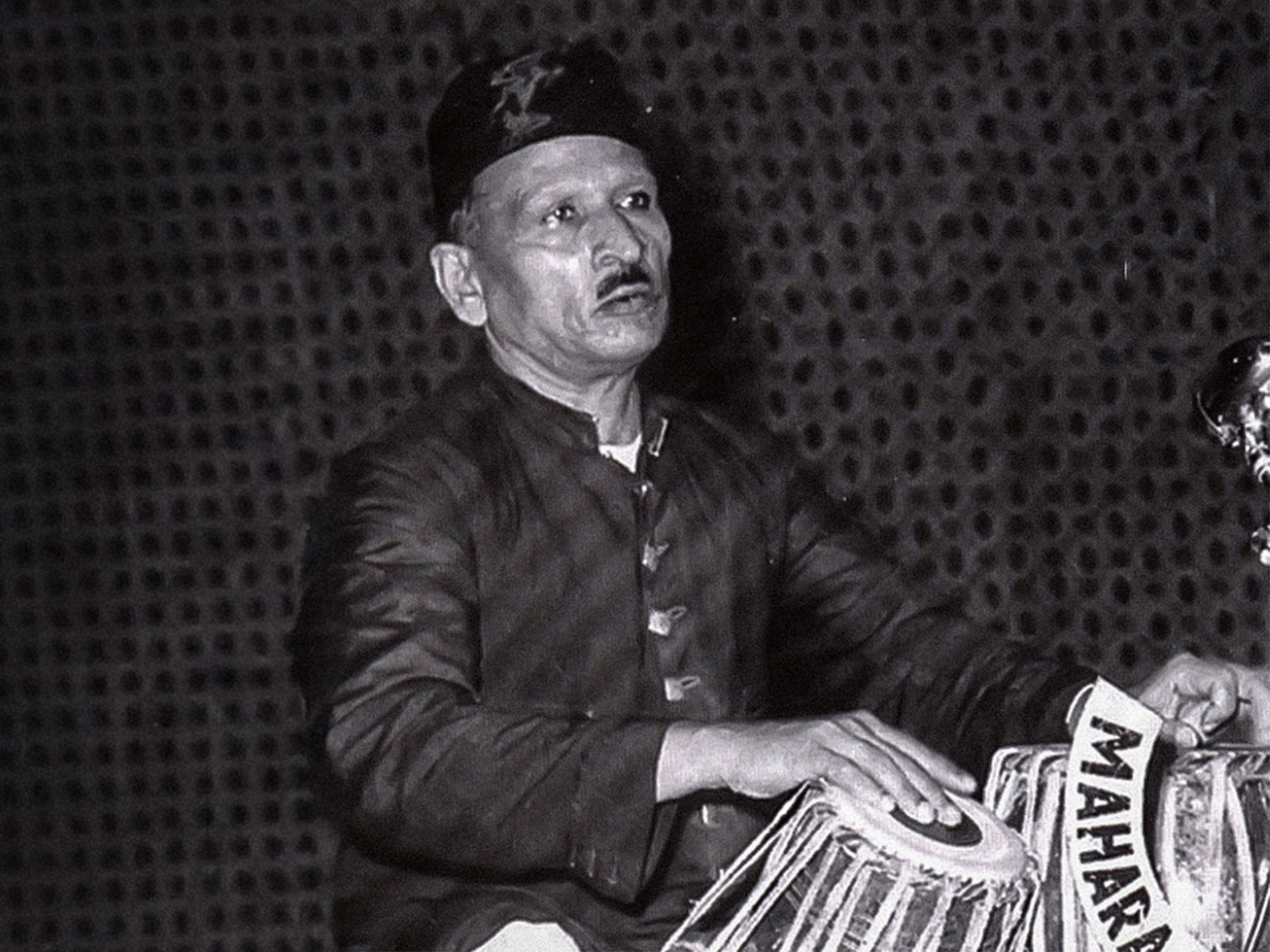
In the vast and luminous constellation of Hindustani classical music, many artists shine brightly, yet only a rare few illuminate the entire musical universe. Ustad Ahmed Jan Khan—reverently remembered as Ustad Ahmed Jan ‘Thirakwa’—was one such radiant presence. His artistry did not merely enrich the tradition of tabla performance; it transformed the very language of rhythm. When he passed away on 13 January 1976, an era of music seemed to pause in silence, as though acknowledging the departure of one of rhythm’s greatest custodians.
Today, remembering Thirakwa Sahib is not merely an act of nostalgia; it is an opportunity to revisit a life that defined discipline, creativity, and artistic excellence.
The Genesis of a Legend
Born in 1892 in Moradabad, Uttar Pradesh, Ahmed Jan entered a family where music was not merely a profession but a way of life. His father, Hussain Bux, was an accomplished sarangi player, and the young boy grew up surrounded by the tonal richness of classical performance. Yet destiny had chosen a different instrument for him—the tabla, the twin drums whose voice he would later elevate to unparalleled heights.
His formal training began under the legendary Ustad Munir Khan, a towering figure of the Farrukhabad gharana. The discipline imposed during his training was austere and almost monastic. Oral histories and disciples’ recollections suggest that the young Ahmed Jan often practised up to sixteen hours a day, refining not only speed and dexterity but also tonal clarity and rhythmic intelligence. Such devotion laid the foundation for the mastery that would later astonish audiences across the subcontinent.
The Birth of “Thirakwa”
The name by which history remembers him emerged from a moment of spontaneous admiration. While the young Ahmed Jan was deeply absorbed in practice, Ustad Kale Khan—father of his guru—heard the shimmering precision of the boy’s fingers striking the drumheads. Struck by the fluidity and dancing brilliance of the strokes, he reportedly exclaimed, “Tera haath to thirakta hai!”—“Your hands seem to dance.”
The word “Thirak” in Hindustani suggests a graceful tremor, a shimmering movement, something alive with rhythmic sparkle. From that day onward, Ahmed Jan became “Thirakwa,” a name that would come to symbolise elegance, precision, and rhythmic vitality.
A “Choumukhi” Master of Gharanas
In tabla tradition, stylistic lineages—known as gharanas—carry distinct techniques, tonal approaches, and aesthetic philosophies. Delhi emphasises crisp fingering, Ajrara is renowned for complex cross-rhythms, Lucknow for expressive resonance, and Farrukhabad for balance and compositional refinement.
Ustad Thirakwa achieved something exceedingly rare: he internalised the vocabulary of multiple gharanas and synthesised them into a unified, personal style. Musicians often described him as a “Choumukhi” (four-faced) artist, capable of presenting multiple stylistic dimensions with equal authority. His playing possessed the delicacy of Delhi, the intellectual depth of Ajrara, and the majestic resonance of Lucknow and Farrukhabad, yet always remained unmistakably his own.
This synthesis allowed him to move effortlessly between accompaniment and solo performance, maintaining both structural rigour and aesthetic grace.
From Royal Courts to Modern Institutions
Thirakwa Sahib’s career spanned a remarkable historical transition. He began performing in the princely courts of India—most notably serving for nearly three decades in the court of the Nawab of Rampur—where classical musicians enjoyed royal patronage and long-term artistic stability. In these courts he accompanied many of the greatest vocalists and instrumentalists of his era, absorbing a vast repertoire and refining his sensitivity to musical dialogue.
Following Indian independence and the gradual disappearance of princely patronage, many court musicians struggled to adapt. Thirakwa, however, successfully transitioned into the modern institutional era. He served as a distinguished professor at the Bhatkhande Music Institute in Lucknow and later contributed to national institutions dedicated to preserving classical arts. Through teaching, he transmitted not only compositions and techniques but also an ethos of disciplined practice and artistic humility.
The “Lazzat” of His Playing
Connoisseurs frequently spoke of the “lazzat”—the flavour or aesthetic savour—of Thirakwa’s tabla. Though the instrument is fundamentally percussive, his playing often seemed melodic, almost vocal in its phrasing. His command over tonal modulation, particularly on the bayan (bass drum), was legendary; he could produce rolling thunder-like resonance one moment and a delicate humming vibration the next.
His solo recitals were celebrated events. Audiences often reported that he could perform for hours without repeating a composition, sustaining both technical brilliance and emotional engagement. For him, rhythm was not merely mechanical precision but expressive speech. As he famously remarked:
“It is easy to play the tabla, but difficult to draw melody from it.”
This philosophy defined his approach—each rhythmic phrase had to carry musical meaning.
The Man Behind the Maestro
Beyond the stage, Thirakwa Sahib possessed a vibrant personality. He was known for his elegant attire—often dressed in a finely tailored sherwani and traditional cap—and for his appreciation of life’s finer pleasures, including kite flying, perfumes, and culinary delicacies. Yet these personal tastes never distracted from his artistic seriousness.
Even in advanced age, he maintained a rigorous practice routine. When admirers asked why he continued practising so diligently after achieving worldwide recognition, he would respond with characteristic humility:
“Music is an ocean; I am merely a child gathering pebbles on the shore.”
The Eternal Resonance
When Ustad Ahmed Jan Thirakwa passed away in Lucknow on 13 January 1976, the world of rhythm lost one of its greatest architects. Yet his legacy did not fade; it became embedded in the very grammar of tabla performance. Generations of artists—across gharanas and stylistic traditions—continue to study his recordings, compositions, and aesthetic approach as foundational references.
Today, whether in concert halls, music academies, or informal practice rooms, his influence continues to resonate. Every nuanced stroke, every carefully balanced phrase, and every attempt to make rhythm sing carries, in some measure, the imprint of Thirakwa Sahib’s vision.
On his death anniversary, we remember not merely a virtuoso performer, but a transformative figure who elevated the tabla from an accompanying instrument to a powerful expressive voice. His fingers did more than strike the drum—they awakened rhythm itself, leaving behind a legacy that still echoes across the musical world.