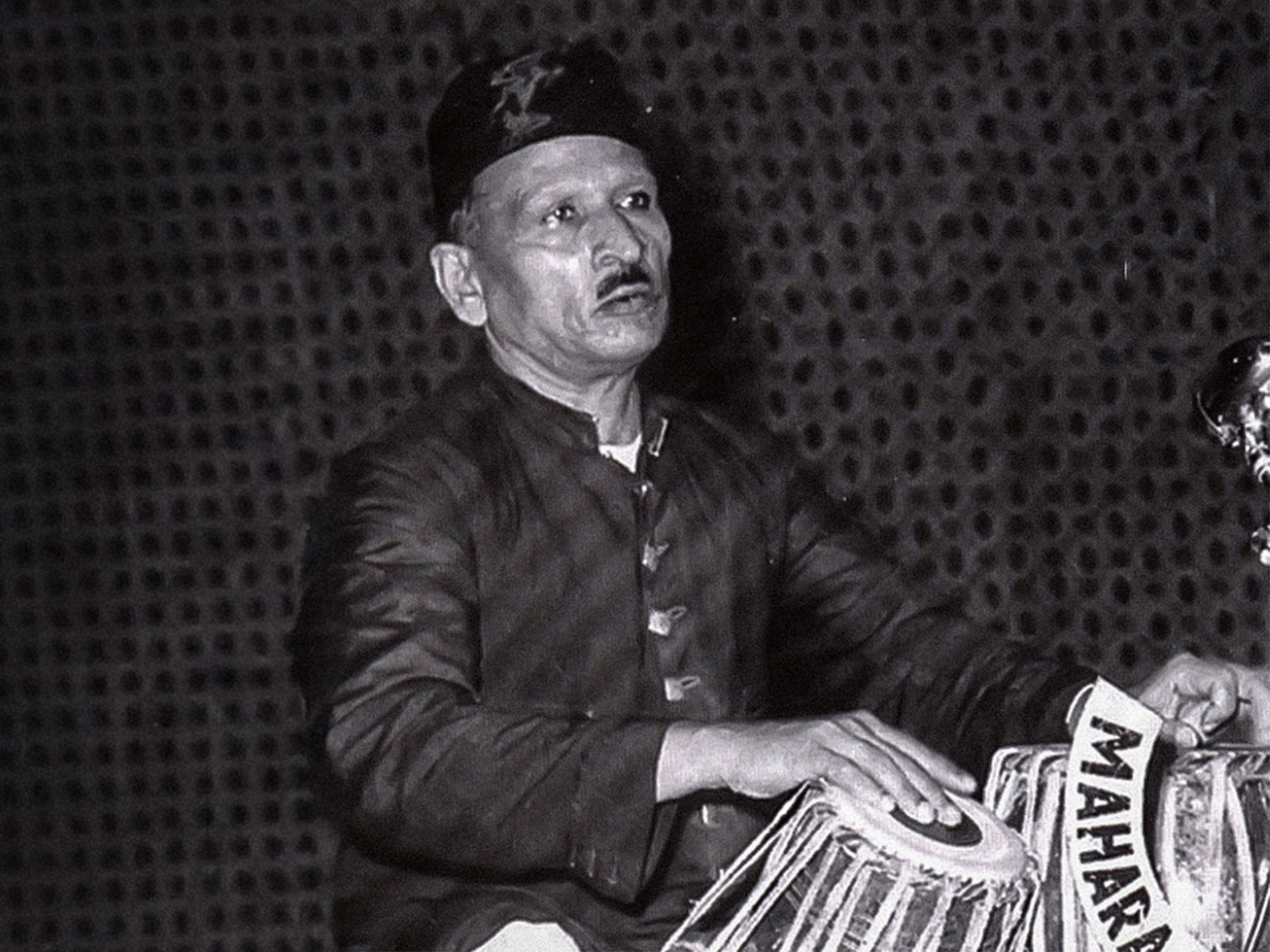
In the long and distinguished history of Hindustani classical music, very few percussionists have altered the aesthetic destiny of their instrument. Ustad Ahmed Jan Thirakwa stands among those rare masters whose artistry reshaped not merely performance practice but the philosophical understanding of rhythm itself. To the casual listener, the tabla may appear to be a pair of drums designed to maintain tempo; to the discerning rasika, however, Thirakwa’s tabla functioned as a narrative instrument—one capable of speech, emotion, and melodic suggestion.
At the centre of his artistic legacy lies a concept frequently invoked by musicians and critics alike: lazzat. Literally meaning “flavour” or “savour” in Urdu, lazzat in the musical context refers to an aesthetic richness that transcends technical precision. In Thirakwa’s hands, each stroke of the drum possessed tonal personality, expressive nuance, and a sense of living resonance. He did not merely strike the instrument; he coaxed sound from it, revealing musical possibilities that many had scarcely imagined.
The Vocal Sensibility of a Percussionist
One of the most remarkable features of Thirakwa’s playing was its unmistakably vocal character. Although the tabla is primarily a rhythmic instrument, he approached it with the sensibility of a khayal vocalist, shaping phrases as though they were melodic lines rather than percussive sequences. This sensibility was most evident in his extraordinary command over the bayan, the bass drum, whose tonal elasticity he elevated to an expressive art form.
Through subtle adjustments of hand pressure and palm movement, he was able to produce a remarkable spectrum of resonance. At one moment the bayan would release a deep, rolling vibration reminiscent of distant thunder; at another it would glide delicately between tonal shades, creating a sonic effect analogous to the meend—the smooth transition between notes so central to Indian vocal music. Such modulation endowed his rhythmic phrases with a breathing, organic quality that blurred the conventional boundary between rhythm and melody.
Rhythm as Expressive Language
Thirakwa often remarked that “it is easy to play the tabla, but difficult to extract melody from it.” This deceptively simple observation served as the guiding principle of his entire musical philosophy. For him, rhythm was not a mechanical structure governed solely by mathematical patterns; it was a language capable of articulation and meaning. Each bol—the mnemonic syllable representing a stroke—had to possess identity, emotional weight, and musical purpose.
He frequently criticised what he termed “dry playing,” performances that prioritised speed or numerical complexity over musical expression. Instead, he treated rhythmic compositions as sentences in a spoken language: a qaida was a thematic statement, its paltas variations of thought, and the concluding tihai the rhetorical cadence that resolved the musical argument. If a phrase lacked recognisable character—what he called a shakal, or “face”—he regarded it as artistically incomplete.
This approach transformed the role of the tabla from a mere time-keeping device into a melodic partner capable of dialogue with vocalists and instrumentalists alike. Subsequent generations of percussionists, consciously or otherwise, inherited this philosophy, striving to achieve the elusive “singing quality” that became synonymous with his name.
The Aesthetic Authority of the Solo Recital
In the early twentieth century, a solo tabla recital was rarely regarded as a major concert attraction. Thirakwa altered this perception decisively. His performances were not demonstrations of technical endurance alone; they were carefully structured journeys through rhythm, unfolding gradually from stately introductory passages to dazzling climactic sequences. Listeners often remarked that he could perform for hours without repeating a composition, yet the music never felt repetitive. Instead, each movement revealed a new shade of tonal colour or rhythmic imagination.
The success of these recitals rested on his ability to balance intellectual sophistication with emotional immediacy. Rapid passages displayed astonishing finger dexterity, yet even at extreme speed the clarity of individual strokes remained intact. More importantly, the emotional arc of the performance—its tension, repose, and ultimate resolution—kept audiences profoundly engaged. For Thirakwa, a recital was less an exhibition of virtuosity than a form of musical storytelling, in which rhythm served as both narrative voice and dramatic structure.
The Farrukhabad Foundation
To understand the architectural elegance of his art, one must examine the tradition from which he emerged: the Farrukhabad gharana. Distinguished by its compositional richness, balanced tonal design, and refined aesthetic temperament, the gharana provided an ideal foundation for Thirakwa’s musical imagination. While other schools emphasised either percussive power or intricate rhythmic calculation, Farrukhabad cultivated breadth, nuance, and melodic sensibility—qualities that found their ultimate expression in his playing.
His mastery of the qaida form exemplified this approach. Beginning with a deceptively simple thematic phrase, he would gradually unfold a series of variations, each exploring new tonal or rhythmic possibilities while preserving the integrity of the original motif. The interplay between bhari (resonant strokes) and khali (lighter or silent strokes) created a rhythmic breathing pattern, lending his performances a sense of organic expansion rather than mechanical progression.
The Precision of the Dancing Fingers
Observers frequently remarked that Thirakwa’s fingers did not appear to strike the drum; they seemed to dance upon it. This metaphor, often repeated in musical circles, was not merely poetic exaggeration. His technical approach rested on extraordinary economy of motion—every stroke placed with surgical precision, every movement measured yet fluid. Power was never produced through force; it emerged from exact placement and timing.
Particularly celebrated was his execution of rapid passages such as tirakit, a four-syllable phrase requiring exceptional dexterity. In lesser hands such passages often dissolved into indistinct sonic blur; under Thirakwa’s touch, however, each syllable remained sharply articulated, producing what listeners described as “crystalline clarity.” His control over the chanti, the rim of the wooden dayan, introduced a bright metallic resonance that complemented the deep tonal foundation of the bayan, creating a complete tonal spectrum within the instrument itself.
Compositional Elegance: Gat, Tukra, and Structural Poetry
Another defining feature of his musicianship was the refined manner in which he rendered composed pieces such as gats and tukras. These compositions, inherited through generations of the Farrukhabad lineage, were treated by him not merely as rhythmic formulas but as carefully shaped artistic statements. He resisted the temptation to accelerate excessively, preferring instead a dignified tempo that allowed the listener to absorb the full aesthetic flavour of the composition. Each phrase unfolded with narrative clarity, enabling even complex rhythmic structures to appear effortless and graceful.
In many performances, the structural logic of his compositions resembled poetic architecture. A theme would emerge, develop through variations, and conclude with a tihai—a thrice-repeated cadence landing precisely on the first beat of the cycle. His tihais were celebrated for their subtle unpredictability: he often began them from unexpected points within the rhythmic cycle, creating suspense before resolving with impeccable precision. The resulting effect was not merely technical satisfaction but dramatic musical fulfilment.
The Aesthetic Presence of the Maestro
Beyond technique, Thirakwa’s stage presence itself reshaped the cultural perception of the tabla artist. In earlier periods, percussionists were frequently regarded as accompanists occupying a secondary role. Thirakwa’s dignified posture, calm demeanour, and regal composure altered this perception profoundly. Seated upright with effortless stillness, dressed often in an immaculate sherwani and traditional cap, he embodied a visual elegance that matched the sophistication of his music. Audiences encountered not a time-keeper, but a maestro whose instrument commanded intellectual and aesthetic respect.
The Rampur Court: Refinement and Recognition
A crucial chapter in his artistic life unfolded during his long association with the princely court of Rampur, where he served for nearly three decades. The Nawab, an enlightened patron of the arts, recognised Thirakwa not merely as a court musician but as a cultural treasure. Courtly life refined both his musical sensitivity and personal style, reinforcing the aesthetic discipline that later defined his public performances.
Numerous anecdotes from this period illustrate his extraordinary musical confidence. In one celebrated incident, a renowned vocalist attempted to overwhelm the accompanist with extremely rapid melodic passages. Rather than competing through speed alone, Thirakwa responded by reproducing the expressive tonal glides of the vocalist on the bayan, demonstrating that rhythmic accompaniment could equal vocal expressiveness. The astonished singer reportedly paused mid-performance, acknowledging the tabla maestro’s artistic supremacy.
Another frequently recounted episode involved a vocalist known for accelerating the tempo to exhausting levels. While accompanists often struggled to keep pace, Thirakwa maintained a relaxed composure, his economical fingerwork allowing him to sustain the tempo effortlessly while the vocalist himself grew visibly fatigued. Such moments reinforced his reputation not only as a virtuoso but also as a master strategist of rhythm.
Philosophy of Musicianship: The Three Types of Players
In later years, reflecting on his long career, Thirakwa articulated a simple yet revealing classification of tabla performers. He spoke of three types: the Tabliya, the true master who understands the soul of the instrument; the Hatheliya, who relies on excessive force rather than nuance; and the Hisabiya, who becomes lost in mathematical calculation at the expense of musical expression. His own aspiration, he emphasised, was always to remain a Tabliya—to move the listener’s heart rather than merely impress the intellect.
This philosophy reflected the broader ethos of courtly musicianship in which artistic communication, not technical competition, constituted the ultimate goal. Music, in his view, was not a race to demonstrate speed but a medium through which emotion, refinement, and spiritual depth could be conveyed.
Humility and Pedagogical Grace
Despite towering fame, Thirakwa remained deeply humble. Numerous students recalled occasions when he listened attentively to young performers, offering guidance through demonstration rather than criticism. Instead of displaying superiority, he would often present a simple composition with perfect tonal balance, quietly illustrating the aesthetic principle he wished the student to understand. Such pedagogical gentleness contributed significantly to the enduring reverence he commanded among disciples and colleagues alike.
The Farrukhabad Architecture: Rhythm as Poetic Structure
The deeper one explores Thirakwa’s repertoire, the clearer it becomes that his artistry rested upon a sophisticated architectural understanding of rhythm. Within the Farrukhabad tradition, compositions were not merely technical exercises; they were conceived as rhythmic poems, each possessing structural coherence, tonal balance, and expressive character.
The Purity of the “Nikhad” Gats
Certain compositions emphasised tonal purity and clarity of stroke, often employing carefully balanced sequences such as tirakit–dhet–dha. These short, distilled phrases functioned almost like musical aphorisms—brief yet evocative. Thirakwa rendered them with meticulous tonal symmetry, ensuring that the brightness of the right-hand strokes was complemented by the rounded warmth of the bayan. He believed that every composition should possess an immediately recognisable “face,” allowing listeners to identify it from the very first phrase.
Multi-Layered Rhythmic Narratives: Dupalli and Tipalli
Other compositions explored layered rhythmic weight, presenting the same thematic phrase in different temporal densities within a single rhythmic cycle. Known as dupalli and tipalli gats, these pieces demanded exceptional command over tempo transitions. Thirakwa executed such shifts with remarkable smoothness, moving from slow, deliberate pacing to rapid double-time passages without disturbing the listener’s rhythmic equilibrium. The effect resembled a poetic couplet in which the same idea appears first in reflective whisper and then in emphatic declaration.
The “Chalan”: The Gait of Rhythm
Among the most evocative elements of his repertoire was the chalan, literally meaning “gait” or “movement.” A chalan conveyed the personality of the performer through rhythmic pacing. Thirakwa’s chalans were often described as stately—measured, deliberate, and imbued with quiet authority, reminiscent of the ceremonial stride of a monarch entering a royal court. Each beat carried intention; nothing felt hurried or ornamental.
The Art of Resolution: The Tihai
Every major composition ultimately resolved through the tihai, the thrice-repeated phrase designed to arrive precisely on the first beat of the rhythmic cycle. In Thirakwa’s performances, the tihai functioned not merely as a structural closure but as a dramatic moment of revelation. Frequently he initiated the tihai from unexpected points within the cycle, creating suspense that held audiences in anticipatory silence before the final perfectly timed resolution. The precision of these landings—often achieved after long stretches of improvisation—earned him legendary acclaim among musicians and listeners alike.
A Listening Guide to the “Lazzat”
For listeners seeking to understand the aesthetic flavour of Thirakwa’s playing, several characteristic musical moments provide invaluable entry points.
The Peshkar in Teental
The introductory peshkar reveals his vocal approach most clearly. Performed at a slow tempo, it unfolds gradually, allowing the resonant glide of the bayan to establish an atmospheric foundation reminiscent of the opening phrases of a raga.
The “Dhaere Dhaere” Qaida
Perhaps his most celebrated thematic composition, this qaida demonstrates the clarity of his fingerwork. Even as tempo increases, each stroke retains distinct articulation, illustrating his belief that speed must never sacrifice tonal definition.
Jhaptal Solo Performances
In the asymmetrical ten-beat cycle of Jhaptal, his sense of rhythmic balance becomes evident. Suspenseful approaches to the sam (the first beat) and elegantly constructed tihais exemplify his architectural mastery of rhythm.
Accompaniment with Vocal Masters
Recordings of his accompaniment to leading vocalists reveal another dimension of his artistry: the ability to recede sensitively during melodic passages and respond conversationally during pauses, demonstrating rhythm as expressive dialogue rather than competition.
Rhythm Beyond Mathematics
A revealing pedagogical anecdote captures the essence of Thirakwa’s philosophy. When a young student once attempted to impress him with dazzling speed, the maestro reportedly stopped the performance and asked gently, “You are playing the letters—but where are the words? And if there are no words, where is the story?” For Thirakwa, rhythmic syllables were merely the alphabet; the true task of the musician was to construct meaningful sentences capable of communicating emotion.
The Enduring Legacy of Lazzat
The concept of lazzat—that elusive aesthetic savour—remains the central measure by which many tabla connoisseurs continue to evaluate performance today. Technical perfection, he demonstrated, is only the beginning; the true achievement of artistry lies in revealing the melody hidden within rhythm. By elevating tonal nuance, structural elegance, and expressive depth to the forefront of percussion performance, Ustad Ahmed Jan Thirakwa permanently transformed the artistic possibilities of the tabla.
More than a virtuoso performer, he was an architect of rhythmic aesthetics. His compositions continue to be studied, his recordings analysed, and his interpretive philosophy transmitted across generations of musicians. Each time a tabla phrase is shaped with melodic sensitivity rather than mechanical precision, the spirit of his musical vision quietly lives on.
In remembering Thirakwa, we do not merely honour a historical figure; we acknowledge a musician who taught the world that rhythm, when touched by imagination and discipline, can speak with the eloquence of song.